Įvadas
The Kaito KA350GY Voyager Trek is a versatile multi-powered radio designed for emergency preparedness and outdoor activities. It features AM/FM, Shortwave (SW), and NOAA Weather band reception, a 5-LED flashlight, and a USB charging port for external devices. This manual provides instructions for its setup, operation, maintenance, and troubleshooting.
Pagrindinės savybės
- Daugiajuostis radijas: Receives AM (530-1710KHz), FM (87-108MHz), Shortwave (SW1: 3-8 MHz, SW2: 9-18 MHz), and 7 pre-programmed NOAA Weather channels.
- Keli maitinimo šaltiniai: Internal rechargeable Ni-MH battery (charged via hand crank, solar panel, USB, or optional AC/DC adapter), and 3 AAA batteries (not included).
- 5 LED žibintuvėlis: Integrated super bright flashlight for illumination.
- USB įkrovimo prievadas: Allows charging of external devices like cell phones and MP3 players.
- Kompaktiškas ir nešiojamas dizainas: Ideal for emergencies, campir kelionės.
Sąranka
1. Baterijos įdėjimas ir pradinis įkrovimas
The KA350GY comes with a built-in rechargeable Ni-MH battery pack. Before initial use, ensure this battery pack is properly connected. It is typically located within the AAA battery compartment. If using optional AAA batteries, insert three AAA batteries into the compartment, observing correct polarity.
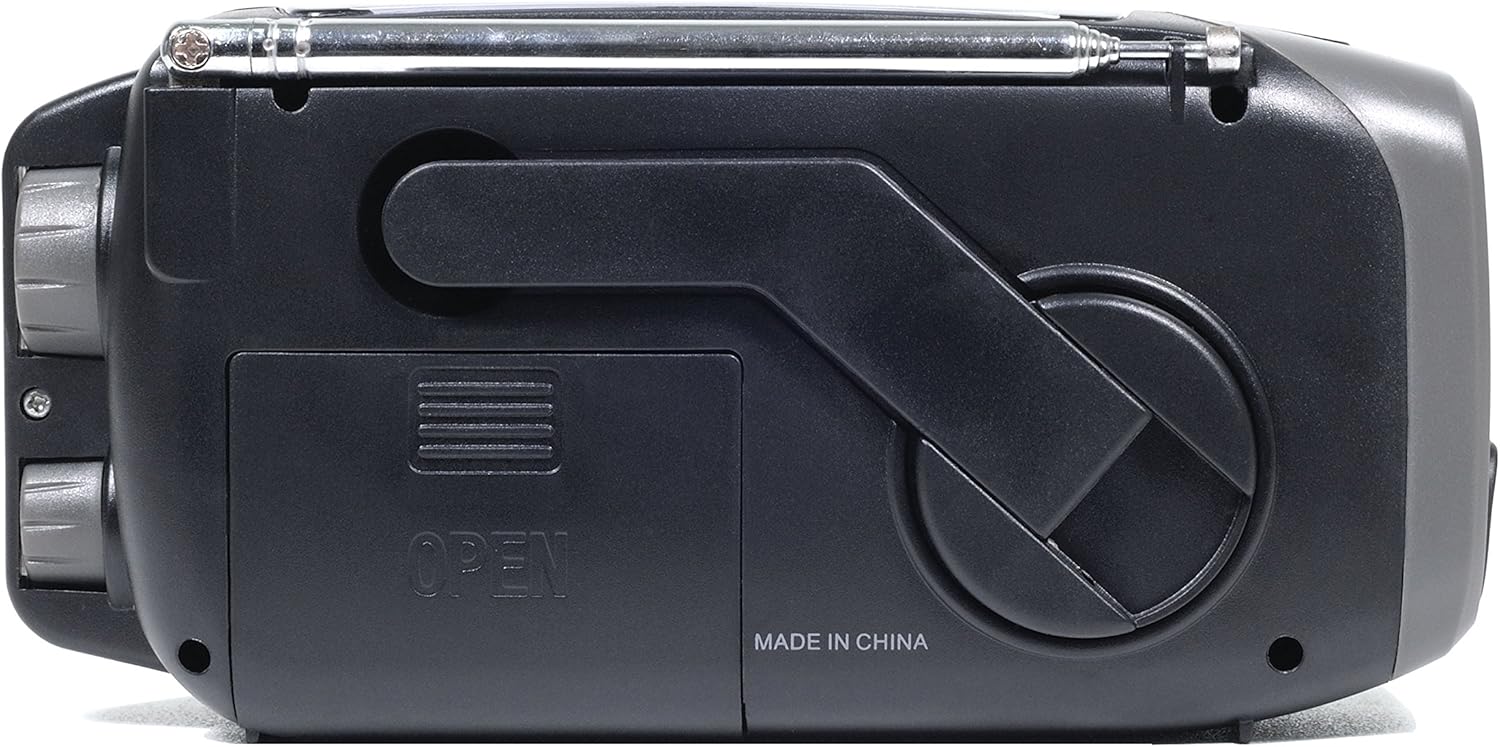
Vaizdas: Galinis view of the radio, highlighting the battery compartment and hand crank.
For optimal performance, fully charge the internal Ni-MH battery before first use. Use one of the following methods:
- USB įkrovimas: Connect the radio to a computer's USB port or a USB wall adapter (not included) using the provided USB cable.
- Rankinis švaistiklis: Rotate the hand crank clockwise or counter-clockwise for several minutes. Ensure the crank is turned gently and kept properly aligned to prevent damage.
- Saulės skydas: Place the radio with the solar panel facing direct sunlight. Note that solar charging provides a trickle charge and is best for maintaining battery life or operating the radio without draining the battery, rather than a rapid full charge.
2. Power Source Selection
Locate the power source switch. For most operations, set it to the "Power" position to utilize the internal rechargeable battery or external power. If using AAA batteries, switch to the "Battery" position.
Naudojimo instrukcijos
1. Radijo ryšys
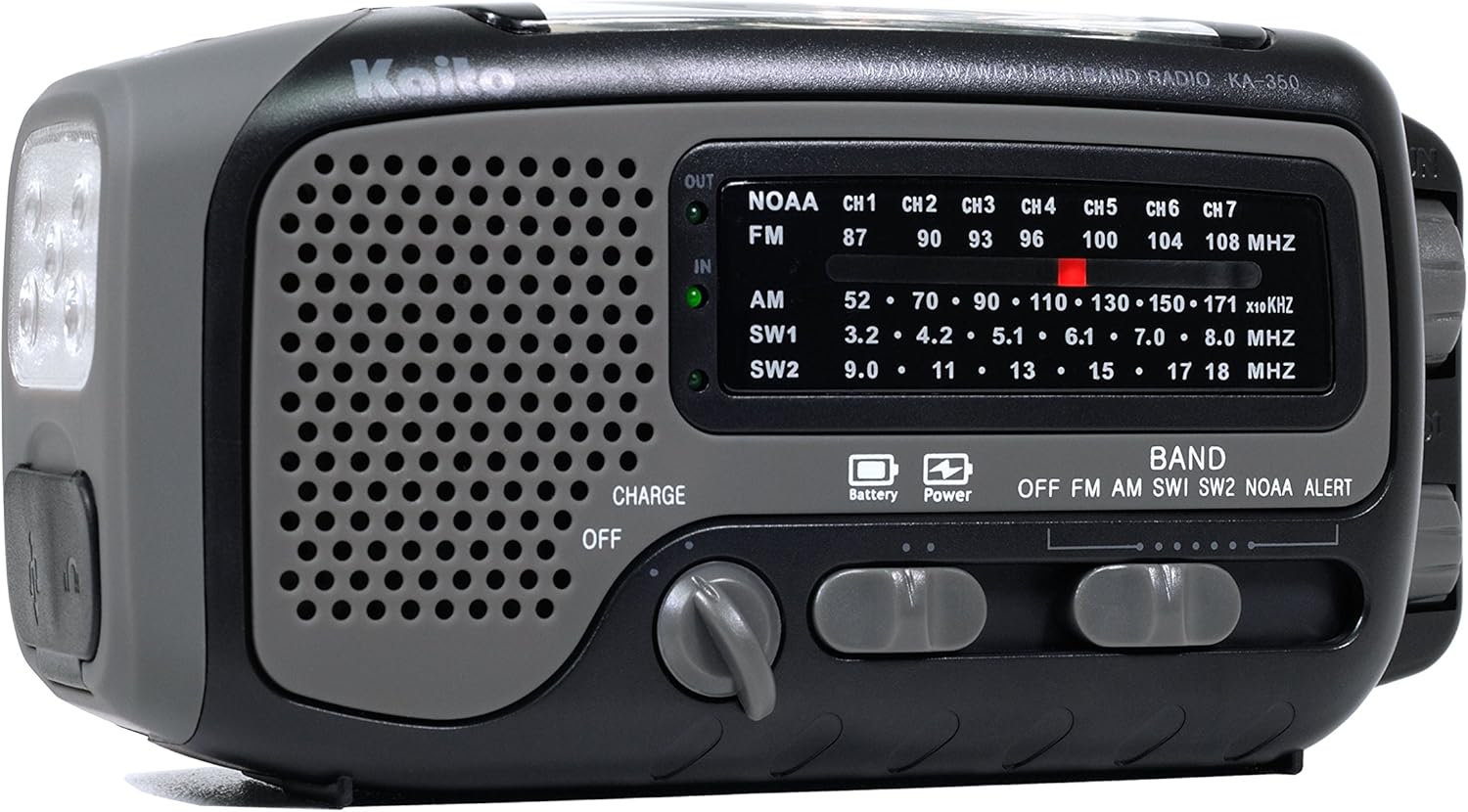
Vaizdas: priekis view of the radio, displaying the speaker, tuning dial, and band selection switches.
- Įjungti: Rotate the Volume knob clockwise to turn on the radio and adjust the volume.
- Pasirinkite grupę: Use the BAND switch to select between OFF, FM, AM, SW1, SW2, NOAA, or ALERT.
- Derinimo stotis: Rotate the TUNING knob to find your desired station. Extend the telescopic antenna for better FM and SW reception. For AM, rotate the radio for optimal signal.
- NOAA orų kanalai: The 7 NOAA channels are pre-programmed. Simply select the NOAA band, and then use the channel selector to choose between CH1-CH7.
- NOAA Alert: In ALERT mode, the radio will remain silent until a weather alert is broadcast, at which point it will sound an alarm and play the alert message.
2. Žibintuvėlio veikimas

Vaizdas: kampuotas view of the radio, highlighting the 5-LED flashlight and the hand crank.
Press the FLASH LIGHT button located near the flashlight to turn it on or off. The flashlight uses 5 LEDs for bright illumination.
3. Išorinių įrenginių įkrovimas

Paveikslėlis: Pabaiga views of the radio, illustrating the USB output port for charging external devices and the micro-USB input for charging the radio itself.
The radio features a USB output port (labeled "OUT") to charge small electronic devices such as cell phones, MP3 players, or digital cameras. Connect your device's charging cable to this port. Ensure the radio has sufficient charge in its internal Ni-MH battery for effective charging.
Note: Direct charging of some high-power devices may be slow or inconsistent. For more reliable charging of such devices, consider charging an external power bank with the radio first, then using the power bank to charge your device.
Priežiūra
- Akumuliatoriaus priežiūra: If storing the radio for extended periods without use, remove any AAA batteries to prevent leakage and damage. The internal Ni-MH battery should be periodically charged to maintain its health.
- Reguliarus testavimas: To ensure readiness, operate and test all radio functions at least once a year.
- Valymas: Radijo išorę nuvalykite minkšta,amp audinys. Venkite naudoti stiprių cheminių medžiagų ar abrazyvinių valiklių.
- Elkitės atsargiai: The hand crank and telescopic antenna are delicate components. Operate the hand crank gently and extend/retract the antenna with reasonable care to prevent bending or breakage.
- Saugykla: Store the radio in a cool, dry place away from extreme temperatures and direct sunlight.
Trikčių šalinimas
| Problema | Galima priežastis / sprendimas |
|---|---|
| Radijas neįsijungia. |
|
| Poor radio reception (AM/FM/SW). |
|
| Išorinis įrenginys neįkraunamas. |
|
| Hand crank feels stiff or breaks. |
|
Specifikacijos
- Modelis: KA350GY
- Matmenys (P x P x A): Apytiksliai 6 x 2 x 3 colio (15.24 x 5.08 x 7.62 cm)
- Svoris: Maždaug 8 uncijos (227 gramai)
- Radijo grupės:
- AM: 530–1710 kHz
- FM: 87–108 MHz
- Shortwave (SW1): 3 - 8 MHz
- Shortwave (SW2): 9 - 18 MHz
- NOAA Weather: 7 pre-programmed channels
- Maitinimo šaltiniai:
- Internal Rechargeable Ni-MH Battery Pack
- 3 x AAA baterijos (į komplektą neįeina)
- Rankinis alkūninis Dinamo
- Saulės skydas
- USB Input (5V DC)
- Žibintuvėlis: 5-LED
- Išvestis: USB (išoriniams įrenginiams įkrauti)
- Įtraukti komponentai: Earphone, User Manual
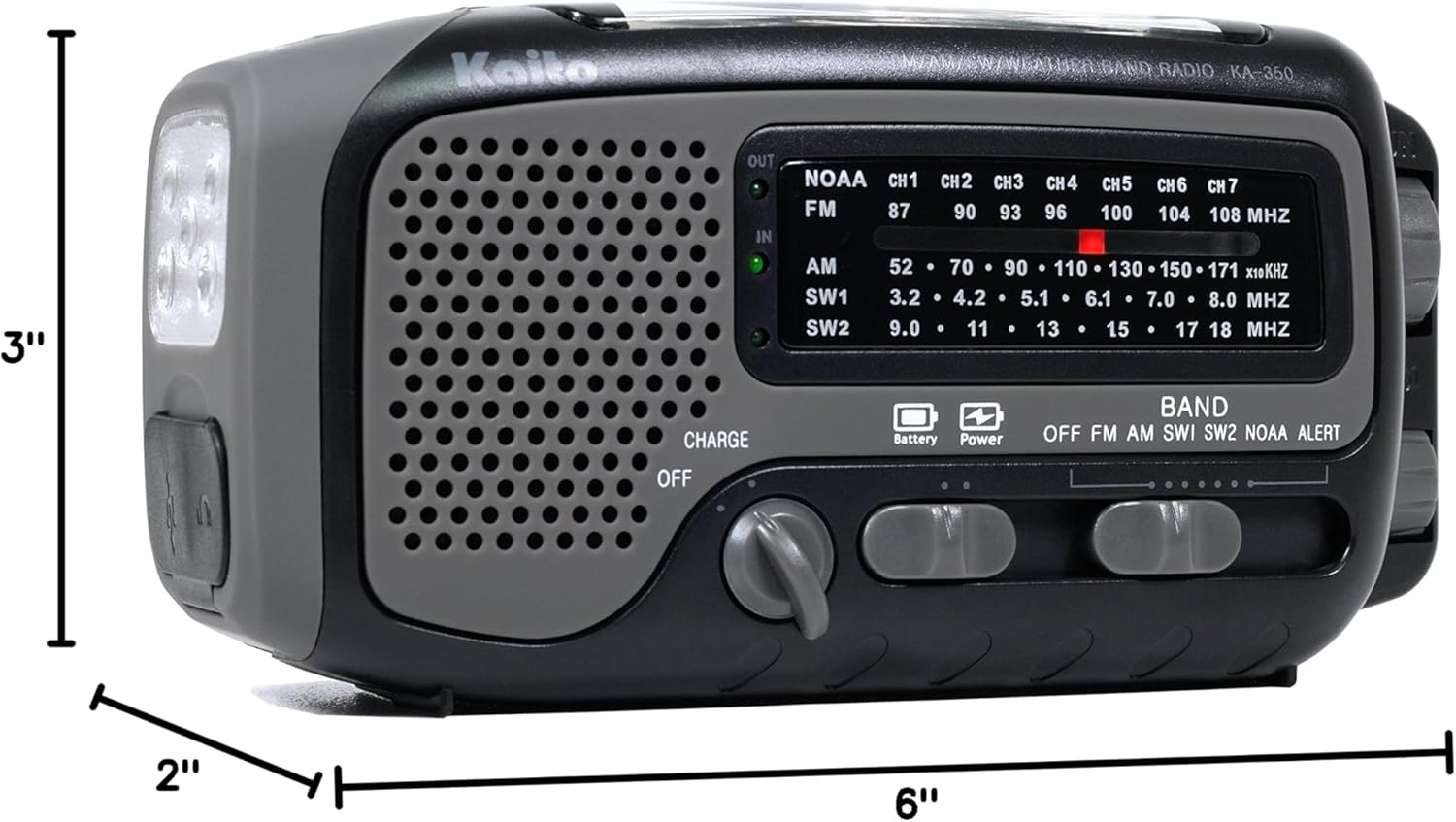
Image: Diagram illustrating the physical dimensions of the Kaito KA350GY radio.
Informacija apie garantiją
Warranty details for the Kaito KA350GY radio are typically provided with the product packaging or can be found on the official Kaito website. Please refer to these sources for specific terms and conditions regarding your product's warranty coverage.
Pagalba klientams
For technical assistance, troubleshooting beyond this manual, or inquiries about your Kaito KA350GY radio, please visit the official Kaito website or contact their customer support using the information provided in your product documentation.


