1. Įvadas
This manual provides instructions for the proper setup, operation, and maintenance of your Levenhuk 720B Binocular Microscope. Please read these instructions carefully before using the instrument to ensure correct usage and to prolong its lifespan. This microscope is designed for laboratory, clinical, and medical research applications.
2. Produktas baigtasview
The Levenhuk 720B is a binocular compound microscope featuring multiple objective lenses and eyepieces for various magnification levels. It includes a mechanical stage, LED illumination, and coarse/fine focusing mechanisms.

2.1 pav.: priekis view of the Levenhuk 720B Binocular Microscope, showing the binocular head, objective lenses, mechanical stage, and base.
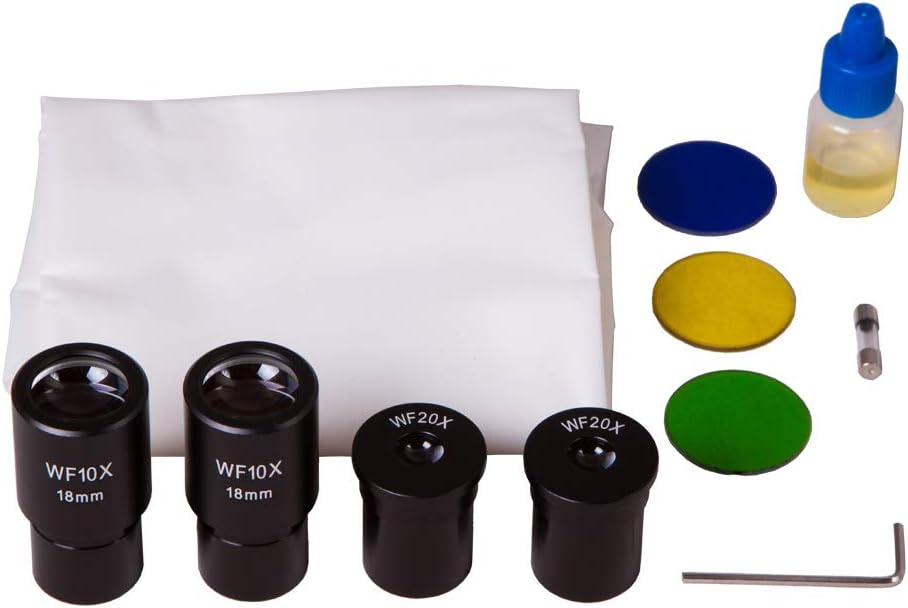
Figure 2.2: Included accessories: WF10x/18mm eyepieces (2), WF20x eyepieces (2), color filters (blue, yellow, green), immersion oil, cleaning cloth, hex key, and spare fuse.
3. Sąranka
- Išpakavimas: Carefully remove all components from the packaging. Retain the original packaging for future transport or storage.
- Vieta: Place the microscope on a stable, level surface away from direct sunlight, high temperatures, dust, and vibrations.
- Maitinimo jungtis: Connect the power cord to the microscope's power input (AC100V-240V, 50/60Hz) located at the rear of the base, then plug it into a suitable electrical outlet. Ensure the power switch is in the OFF position before connecting.
- Okuliaro montavimas: Insert the desired eyepieces (e.g., WF10x) into the eyepiece tubes of the binocular head.
- Binocular Head Adjustment: If the binocular head is rotatable, adjust it to a comfortable viewpadėtis.
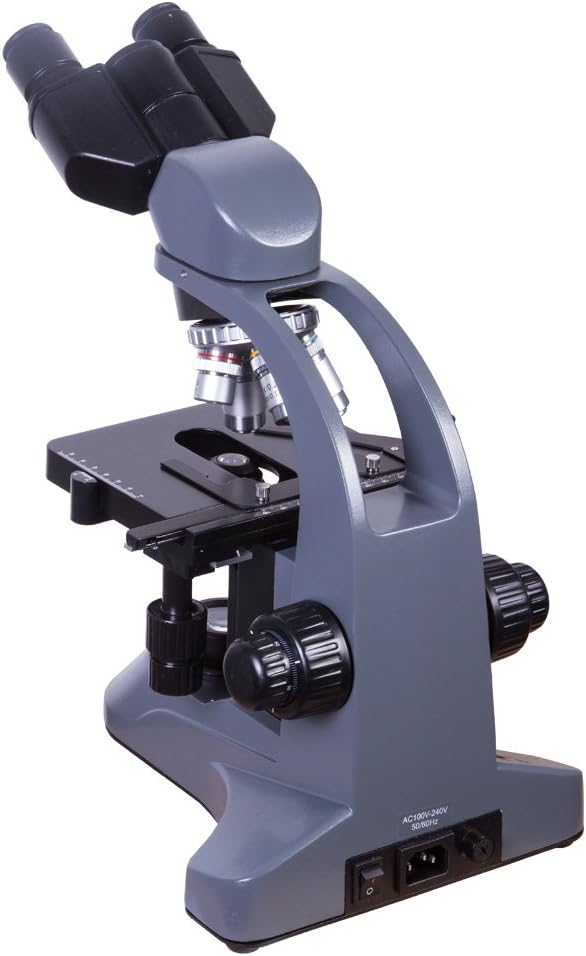
3.1 pav.: galinis view of the microscope showing the power input and switch.
4. Naudojimo instrukcijos
- Maitinimas: Flip the power switch located on the rear of the microscope base to the ON position. Adjust the illumination intensity using the dimmer control.
- Mėginio išdėstymas: Place a prepared microscope slide onto the mechanical stage. Secure it with the stage clips. Use the stage control knobs to center the specimen area of interest over the condenser aperture.
- Magnification Selection: Rotate the revolving nosepiece to select the lowest power objective lens (e.g., 4x). Ensure the objective clicks firmly into place.
- Fokusavimas:
- While looking through the eyepieces, use the coarse focus knob to bring the specimen into approximate focus.
- Tada naudokite fine focus knob for precise focusing until the image is sharp and clear.
- Apšvietimo reguliavimas:
- Adjust the brightness using the dimmer control.
- Adjust the iris diaphragm lever on the condenser to control the amount of light reaching the specimen and improve contrast.
- Tarpinių vyzdžių atstumo reguliavimas: Adjust the distance between the two eyepiece tubes by gently pushing them together or pulling them apart until you see a single, circular field of view.
- Dioptrijų reguliavimas: If one eyepiece has a diopter adjustment ring, focus on the specimen with your dominant eye (usually the right eye) using only the fine focus knob. Then, close your dominant eye and use the diopter adjustment ring on the other eyepiece to focus for your non-dominant eye without touching the fine focus knob.
- Higher Magnification: Once focused at low power, rotate the nosepiece to a higher power objective. Only minor adjustments with the fine focus knob should be needed due to the parfocal design.
- Immersion Oil (for 100x objective): For the 100x objective lens, a drop of immersion oil must be placed directly on the specimen slide. Lower the objective into the oil carefully. After use, clean the 100x objective and slide thoroughly with lens cleaning solution.

4.1 pav. Iš arti view mechaninių stage with the condenser and iris diaphragm visible below.

4.2 paveikslas: View of the illuminated condenser and objective lens from below the stage.
5. Priežiūra
- Lęšių valymas: Use a soft, lint-free lens cleaning cloth and a specialized lens cleaning solution. Never touch optical surfaces with your fingers.
- Bendras valymas: Mikroskopo korpusą nuvalykite minkšta,amp audinys. Nenaudokite abrazyvinių valiklių ar tirpiklių.
- Saugykla: When not in use, cover the microscope with a dust cover to protect it from dust and debris. Store in a dry, cool place.
- Saugiklio keitimas: If the illumination fails, check the fuse located near the power input. Replace it with a fuse of the same type and rating (a spare fuse is included).
6. Problemų sprendimas
| Problema | Galima priežastis | Sprendimas |
|---|---|---|
| Nėra apšvietimo | Power cord disconnected, power switch off, dimmer at minimum, blown fuse. | Check power connection, turn on switch, increase dimmer, replace fuse. |
| Image unclear/blurry | Neteisingas fokusavimas, nešvarus objektyvas, nešvarus okuliaras, stumkite apverstą. | Adjust focus, clean lenses, check slide orientation. |
| Tamsus laukas view | Iris diaphragm closed, low illumination, objective not clicked into place. | Open diaphragm, increase brightness, rotate nosepiece until objective clicks. |
| Two overlapping images | Neteisingas atstumas tarp vyzdžių. | Adjust interpupillary distance until a single field of view yra matomas. |
7. Specifikacijos
- Modelio numeris: 69656
- Prekinis ženklas: Levenhukas
- Maksimalus padidinimas: 2000x
- Šviesos šaltinio tipas: LED
- Objektyvo lęšio aprašymas: Achromatinis
- Tikrasis kampas View: 45 laipsnių
- Maitinimo šaltinis: Su laidu elektra
- ttage: 110 voltų
- Gaminio matmenys: 19.29 x 15.75 x 10.63 colio
- Prekės svoris: 12.36 svaro (5.62 kilogramo)
- UPC: 611901504766
8. Garantija ir palaikymas
For warranty information and technical support, please refer to the documentation provided with your purchase or visit the official Levenhuk websvetainėje. Išsaugokite pirkimo įrodymą garantiniams reikalavimams.


